About Leaf-DETR
Why Leaf-Detr?
Crop growth monitoring is crucial for sustainable agricultural production, as it enables the timely detection and resolution of issues affecting crop health and yield, thereby optimizing resource allocation and enhancing production efficiency. Leaves, being the primary photosynthetic organs, play a pivotal role in this ecosystem by absorbing sunlight, carbon dioxide, and water to synthesize organic compounds essential for plant development. Consequently, monitoring leaf characteristics is indispensable for assessing the overall crop health status. As shown in Figure 1, by combining advanced object detection techniques with downstream tasks to monitor leaves, it is possible to provide comprehensive information regarding leaf distribution, health status, and growth trajectories in complex agricultural environments where there is widespread leaf overlap and plant structures form complex visual patterns. Among them, the dense object detection technology is extremely important for achieving the detection of dense leaves, as the foundation for downstream applications.
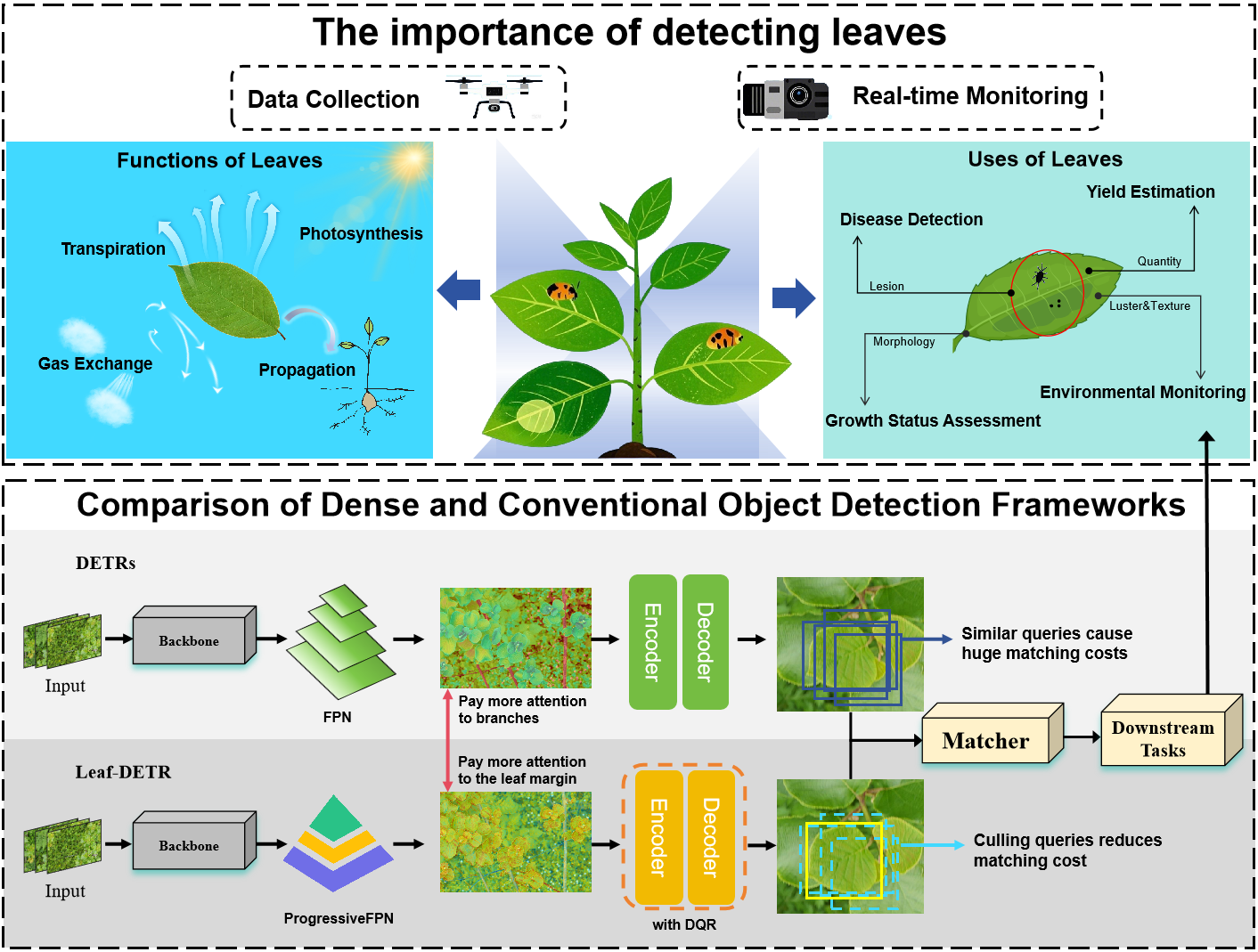
Figure 1: Motivation of leaf-deter. (a) The importance of leaves and the role of detecting leaves. (b) Differences in the DETRs architecture, Leaf-DETR has higher attention to the leaf edges and lower matching cost.
Our pipeline
First, kiwifruit leaf images in the fields are collected by drones. Subsequently, these images are selected and cropped using the sliding window method. The cropped images are first manually annotated in small batches, and then a model is trained for AI annotation. By training on this dataset, Leaf-DETR can accurately detect the leaves, enabling downstream tasks such as disease identification and yield prediction.
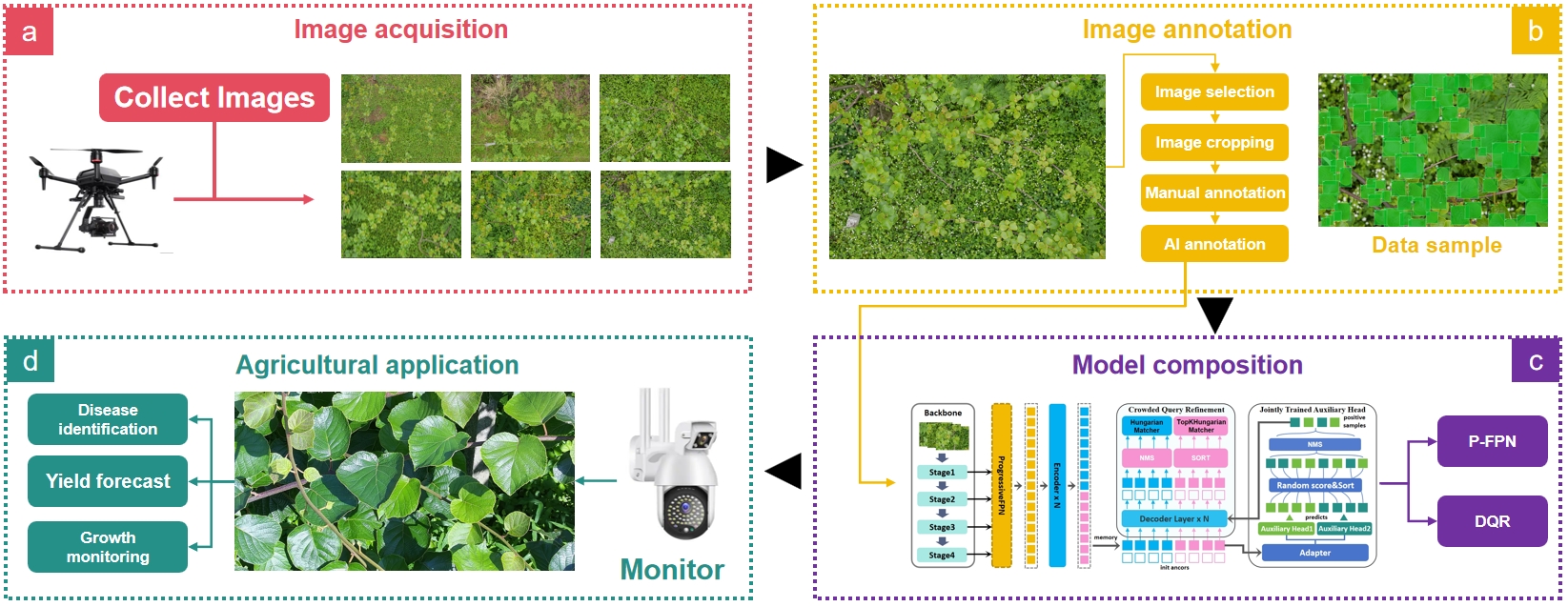
Figure 2: Schematic diagram of kiwifruit leaf Data collection and application. (a) Data collection: Using UAV for high-altitude aerial imaging, (b) Image annotation: Through image screening, cropping, manual annotation, and AI-assisted annotation, (c) Model architecture: The proposed Leaf-DETR framework is equipped with P-FPN, CQR strategy, and the improved JTAH, (d) Agricultural application: Real-time leaf data is acquired through deployed cameras, enabling various downstream applications.