
Leaf-Detr: Progressive Adaptive Network with Lower Matching Cost for Dense Leaves Detection
Leaves are the most important plant organs, and monitoring leaves is a crucial aspect of crop surveillance. Dense leaf detection plays an important role as a fundamental technology for leaf monitoring. The methods for dense leaf detection generally use traditional modular detectors and general feature extraction techniques, without designing methods specifically for dense leaves in reality. In detail, in complex field scenarios, it still faces challenges like incomplete individual feature extraction due to high leaf overlap and difficult network convergence caused by excessive leaf density. To this end, we propose the Leaf-DETR framework, which effectively addresses these challenges through the Progressive Feature Fusion Pyramid Network (P-FPN) and the Crowded Query Refinement Strategy (CQR). First, we construct the largest dense leaf detection dataset to date, containing 1,696 images and 85,375 annotation boxes. Second, P-FPN alleviates the feature confusion problem of overlapping leaves through the multi-stage fusion of features and the Adaptive Feature Aggregation module (AFA), enhancing the interaction between low-level details and high-level semantics. Third, the CQR strategy significantly reduces the matching cost of crowded candidate boxes and improves the network convergence efficiency by culling a crowded query method and introducing a one-to-many matching mechanism. Finally, experiments show that Leaf-DETR outperforms existing detection methods on the self-built dataset and demonstrates good performance generalization in monitoring collected images, as well as for other staple food crops, which verifies its practicality in complex agricultural scenarios.
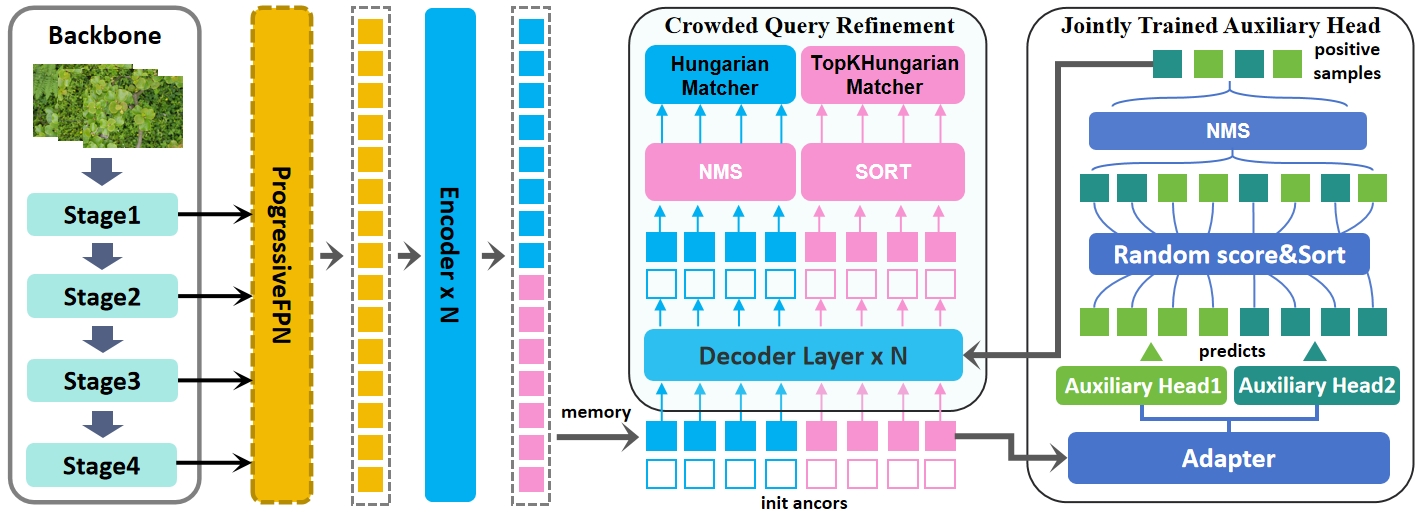
Figure 1: The overall framework of Leaf-DETR. It is equipped with P-FPN, CQR strategy and the improved JTAH. Through the extraction of discriminative features by P-FPN and the efficient training process equipped with CQR, the model is able to possess a powerful dense leaf detection capability.
P-FPN: Progressive Feature Fusion Pyramid Network
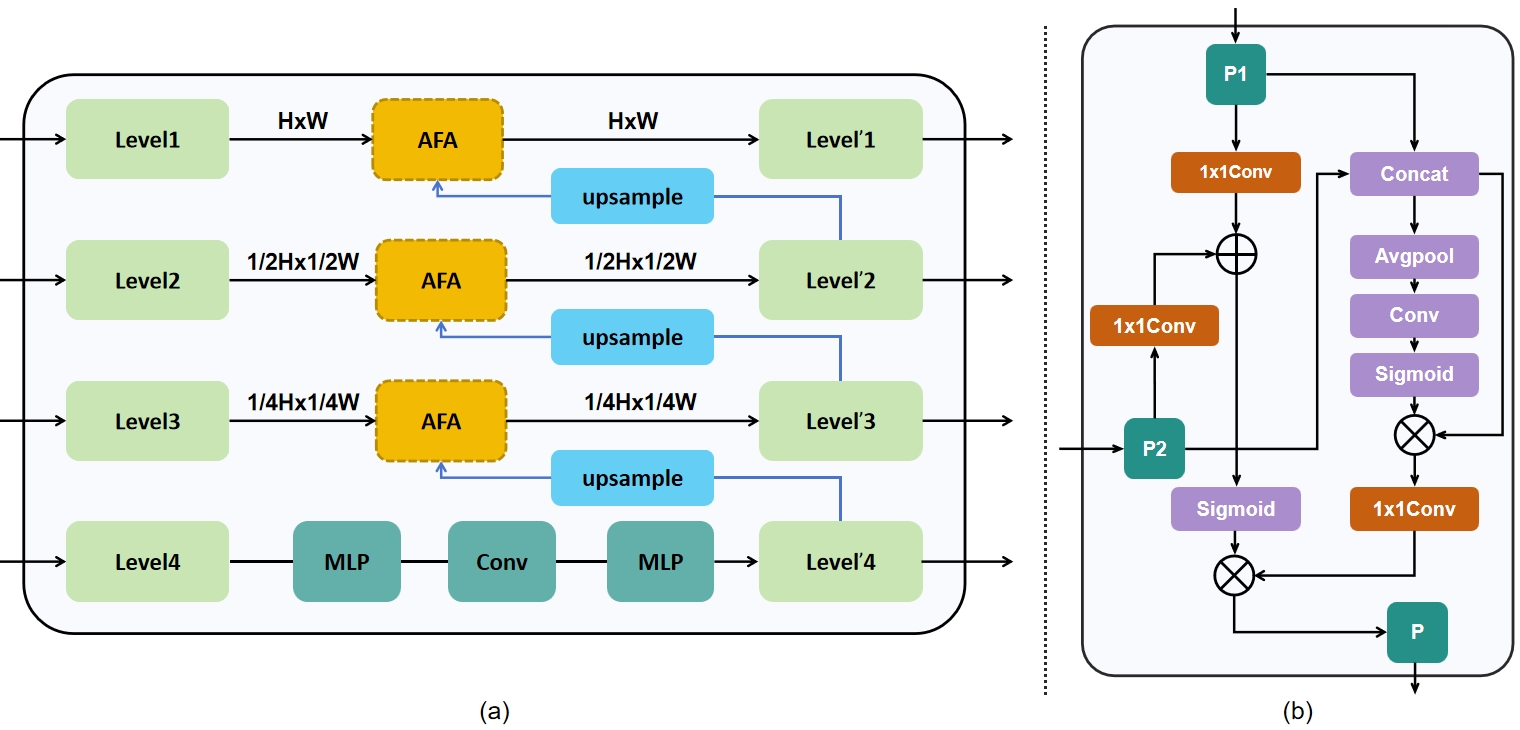
Figure 2: Framework of Progressive Feature Pyramid Network. (a) Progressive architecture: information interaction is achieved through progressive feature fusion of adjacent levels.(b) Adaptive Feature Aggregation: it realizes feature fusion using a dual-path approach. The progressive feature fusion path and the dual-path feature fusion method can extract more discriminative leaf features.
CQR: Crowded Query Refinement Strategy
We adopt a one-to-many matching mechanism during training, combined with NMS to select the optimal detection results. This strategy effectively improves training efficiency and sample utilization, while maintaining model lightweightness, and enhances the robustness of detecting dense, occluded, or small-sized leaves.
JTAH: Improved Jointly Trained Auxiliary Head
We introduce the improved Jointly Trained Auxiliary Head. Referring to the design of CQR, we discard the confidence values in the auxiliary head and instead assign randomized confidence values to each sample and use NMS to suppress the overlapping samples.